


Undescended Testicle Surgery in Indore: Best Pediatric Urologist in Indore
Learning that your infant has an undescended testicle or testes can be frightening. The condition, also known as cryptorchidism, is one of the most prevalent congenital abnormalities of the male genitalia. It is more common in premature infants.
Although most children will see their testicles descend on their own during the first few months, those with cryptorchidism may require surgery to bring the testicle(s) into the scrotum. For such conditions, advice from the best pediatric urologist in Indore, Dr. Saurabh Garge, will help you get timely treatment and proper care.
What is an undescended testicle?
A baby’s testes are formed inside the abdomen while in the womb and usually descend into the scrotum during the last trimester of pregnancy. In cryptorchidism, the testes do not fully descend into the scrotum.
An undescended testicle can either be palpable in the groin or located inside the abdomen. In some cases, the testicle is found “high” in the groin area. It may be possible to feel an undescended testicle, especially in the groin area. The usual presentation, however, is an empty or smaller-than-normal scrotum, and it does not cause much discomfort to the child.
Can an undescended testicle go down on its own?
It is normal for an undescended testicle to descend on its own during the first few months after birth. Beyond about 6 months, spontaneous descent becomes uncommon.
According to current urological practice, a child should be referred to a pediatric surgeon or a pediatric urologist near you for evaluation and treatment if the testicle has not come down on its own by about 6 months of age.
Parents should not rely on the possibility that the condition will improve with time. Instead, they should seek medical advice as soon as possible to determine the exact location of the testes, and the best time to perform surgery, if needed.
Why is an undescended testicle treated?
The testicles normally stay in the scrotum because it is cooler than the abdomen. This cooler temperature is important for healthy sperm production. If a testicle remains in the abdomen or groin for a long time, it may affect fertility later in life.An undescended testicle can also increase the risk of testicular cancer. Surgery called orchiopexy brings the testicle down into the scrotum. This makes it easier to examine and monitor the testicle in the future.
There is also a risk of the testicle twisting, called testicular torsion, and some children may also have an inguinal hernia. For these reasons, treating an undescended testicle at the recommended age is important for the child’s future health.
At what age can an undescended testicle be treated?
The sooner the better also applies when treating an undescended testicle. Current practice indicates that an orchidectomy should be done shortly after the child is about one year old. More precisely, if the testicle has not descended spontaneously by about six months, surgery should be performed within the next 12 months and completed by 18 months at the latest.
Dr. Saurabh Garge, Pediatric Urologist in Indore, considers many factors when determining when to undertake orchiopexy, including the location of the testicle, the age of the child, and whether one or both testes are affected.
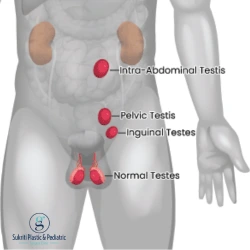
Undescended Testicle Surgery: The Process
- The surgical treatment for an undescended testicle is called orchiopexy. During the procedure, the surgeon brings the testicle into the scrotum and secures it in the correct position.
- If the testicle can be felt in the groin, the surgery is usually performed through a small incision.
- If the testicle cannot be felt during examination, the surgeon may use laparoscopy, a small camera-based procedure, to locate the testicle inside the abdomen.
- If the testicle is located high in the abdomen, the treatment may be more complex and, in some cases, may need to be completed in more than one stage.
Recovery from Undescended Testicle
Most children respond well to an undescended testicle surgery. They may experience discomfort and mild swelling at the incision site in the groin for a few days. Parents can expect the wound to be sore and require special care for a few weeks after the surgery. They must follow the aftercare instructions provided by Dr. Saurabh Garge, kids urologist in Indore, including keeping the incision site clean and dry.
Older children may need to avoid riding a bike or other strenuous activities for several weeks after an orchiopexy. It is also important to schedule follow-up consultations to evaluate the healing process.
Can an undescended testicle be treated in an older child?
An older child can be successfully treated for an undescended testicle or testes. If a parent discovers that their child has an undescended testicle or testes, or when a testicle that was undescended starts to descend later in life, they should consult Dr. Saurabh Garge, best surgeon for kids problems, to determine the most appropriate course of treatment. The timing of treatment depends on the child’s age, the location of the testes, and whether one or both testes are affected.
Parents should also note that a retractile testis is not the same as an undescended testis. A retractile testis can be manually moved from the scrotum into the groin or lower abdomen due to a strong cremasteric reflex. It is not considered to be an undescended testicle and is typically only monitored.
Conclusion
An undescended testicle may seem like a minor problem, but parents should seek treatment for their child as early as possible to ensure future fertility and ease of examination later in life. Dr. Saurabh Garge , pediatric urologist in Indore provides comprehensive care to children with undescended testes and other related ailments. If the testicle of your child has not descended, we encourage you to consult a qualified Pediatric Surgeon and Urologist to help you determine whether an orchiopexy is necessary and when it should be performed.
FAQs
An undescended testicle, also called cryptorchidism, occurs when one or both testes do not move into the scrotum before or shortly after birth.
If the testicle has not descended naturally by around six months of age, parents should consult a pediatric surgeon or pediatric urologist to discuss treatment and the appropriate timing of orchiopexy.
Dr. Saurabh Garge, Pediatric Surgeon and Urologist in Indore, evaluates and treats children with undescended testes and other pediatric urological conditions.
Orchiopexy is a surgical procedure in which the undescended testicle is carefully moved into the scrotum and secured in the correct position.
Yes. Some undescended testicles descend naturally during the first few months after birth. Spontaneous descent becomes much less likely after approximately six months.
Yes. Parents looking for evaluation and treatment of an undescended testicle in Indore can consult Dr. Saurabh Garge for pediatric surgical and urological assessment.
An untreated undescended testicle may be associated with fertility problems, testicular torsion, inguinal hernia, and an increased risk of testicular cancer later in life.
When the testicle cannot be felt during examination, laparoscopy may be used to locate it. The surgical approach depends on its position and condition.
Most children recover well after orchiopexy. Mild pain or swelling may occur for a few days, while strenuous activities may need to be avoided for several weeks as advised by the surgeon.
Orchiopexy surgery in Indore may cost around ₹40,000 to ₹1,20,000, depending on the hospital, surgical technique, and child’s condition.
Tags : best pediatric surgeon and urologist in indorebest pediatric surgeon in IndoreBest Pediatric Urologist in Indorebest surgeon for undescended testicle surgerybest undescended testis treatment in indorebest urologist for kids in indoreDr Saurabh GargeSukriti Clinic Indoreundescended testicle surgery in indore


- Address : Sukriti clinic, Scheme no 74, CH 3, Near Prestige College, Opposite Vrindavan Restaurant, Indore, Madhya Pradesh 452010
-
Phone : +91 702 402 3943,
+91 992 666 3943 - Email : info@sukriticlinic.com