


Difference Between Hernia and Hydrocele in Children
When parents see swelling near their child’s groin or scrotum they get worried. There are two conditions that can cause this swelling: hernia and hydrocele. These conditions look similar. They are actually different and need different types of care. Understanding the difference between hernia and hydrocele in children helps parents make a decision.
Dr. Saurabh Garge, best pediatric surgeon in Indore, often sees parents who are confused between these two conditions. Both conditions can cause swelling around the abdomen or scrotal area. Some cases may get better with monitoring while others may need surgery.
What is a Hernia in Children?
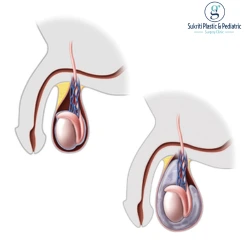
A hernia happens when a part of the intestine or abdominal tissue pushes through an opening in the wall. In children the common type is a hernia, which appears near the groin area. This usually develops because the opening inside the groin does not close properly before birth. Hernias are more common in babies and boys. Girls can also develop them.
Parents may notice a swelling near the groin. The swelling gets bigger when the child cries, coughs or strains. The lump disappears when the child is resting or sleeping. Some children may feel irritable or uncomfortable. A hernia does not heal on its own. Most cases need surgery to close the opening and prevent complications.
What is a Hydrocele in Children?
A hydrocele is different from a hernia. In this condition fluid collects around the testicle causing swelling in the scrotum. Hydrocele is common in babies and infants. This happens when fluid remains trapped after birth. Unlike a hernia there is no intestine or abdominal organ inside the swelling.
Hydrocele swelling is usually painless and smooth in appearance. It is mostly seen on one or both sides of the scrotum. Is more noticeable during the day. It is not associated with discomfort. In babies hydroceles can disappear naturally within the first year of life. Doctors may only advise observation in these cases.
Main Difference Between Hernia and Hydrocele in Children
Both conditions cause swelling. There are important differences. The contents inside the swelling are different. In a hernia the swelling may contain intestine or abdominal tissue. In a hydrocele the swelling contains fluid. The risk level is also different. A hernia can become dangerous if the intestine gets trapped and this condition may need emergency surgery. Hydrocele is usually less risky and often painless.
Hernias always need surgery because they do not close naturally. Hydroceles may disappear on their own in infants. Surgery is usually considered if the swelling continues after one to two years or becomes large. The appearance of the swelling is also different. Hernia swelling may increase during crying or activity while hydrocele swelling usually remains soft and stable.
How are These Conditions Diagnosed?
Doctors usually diagnose hernia and hydrocele during an examination. A pediatric surgeon checks the size, location and behavior of the swelling. Sometimes an ultrasound may be advised to confirm the condition and rule out problems. Parents should never ignore swelling in a child’s groin or scrotum.
When Should Parents Consult a Hernia Doctor in Indore?
Parents should seek advice if they notice:
- Swelling near the groin or scrotum
- An increase in swelling size
- Redness or pain
- Vomiting along with swelling
- A child crying excessively due to discomfort
- Swelling that does not go away
Immediate medical attention by an expert hernia doctor for kids in Indore is needed if the swelling becomes painful or cannot be pushed back gently.
Treatment Options for Hernia and Hydrocele
- Treatment depends on the child’s age and condition.
- Pediatric hernia usually requires surgery to close the opening safely.
- Surgery may be done through open or laparoscopic methods.
- Most children recover quickly and go home the same day or next day.
- Small hydroceles in infants may resolve naturally over time.
- Surgery is advised if the hydrocele persists or increases in size.
- Modern pediatric surgery helps reduce pain, recovery time and hospital stay.
Conclusion
Hernia and hydrocele in children may appear similar. They are different conditions with different treatment approaches. A hernia usually requires surgery because it can lead to complications while hydrocele may sometimes resolve naturally with time. Dr. Saurabh Garge, best doctor for hernia treatment in Indore, provides evaluation and treatment for hernia and hydrocele with child-friendly surgical care and guidance, for parents.
FAQ's
A hernia happens when part of the intestine pushes through a weak area in the abdomen, while a hydrocele is a collection of fluid around the testicle. Dr. Saurabh Garge, pediatric surgeon in Indore, explains that both conditions may look similar but need different treatment approaches.
Most hydroceles are not dangerous and may disappear naturally during the first year of life. However, if the swelling increases or does not go away, medical evaluation is important.
No, pediatric hernias usually do not heal naturally. Surgery is generally required to prevent complications like trapped intestine or pain.
Parents may notice a soft swelling near the groin that becomes larger when the child cries, coughs, or strains. The swelling may reduce while the child is resting.
Hydrocele is usually painless. Some children may feel mild heaviness or discomfort if the swelling becomes large.
Parents should consult a doctor if they notice swelling in the groin or scrotum, sudden pain, redness, vomiting, or swelling that becomes hard or larger.
Yes, pediatric hernia surgery is considered safe and commonly performed. Modern surgical techniques help children recover quickly with minimal discomfort.
Hydrocele usually happens when fluid remains trapped around the testicle after birth. It is common in newborn boys and often improves naturally over time.
Yes, both hernia and hydrocele are commonly seen in newborns and infants, especially in premature babies. Parents should consult Dr. Saurabh Garge, pediatric surgeon in Indore, if they notice swelling near the groin or scrotum.
Doctors usually diagnose hernia and hydrocele through physical examination. In some cases, an ultrasound may be advised to confirm the condition and plan the right treatment for the child.


- Address : Sukriti clinic, Scheme no 74, CH 3, Near Prestige College, Opposite Vrindavan Restaurant, Indore, Madhya Pradesh 452010
-
Phone : +91 702 402 3943,
+91 992 666 3943 - Email : info@sukriticlinic.com