


Anorectal Malformation in Newborns: A Parent's Complete Guide
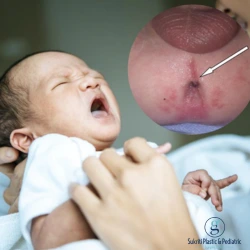
Anorectal malformation (ARM) is a birth defect in which the anus and rectum of a baby do not develop properly. In some babies, it is completely absent, or narrow. While in others, the rectum may connect to the urinary or genital tract with an abnormal opening called a fistula.
Though it can be frightening to learn of an anorectal malformation in a newborn, this congenital abnormality can be corrected successfully with proper pediatric surgery and treatment. Parents of a newborn diagnosed with an absent or abnormal anal opening can consult Dr. Saurabh Garge, Best Pediatric Surgeon in Indore for timely and proper correction.
What Is Anorectal Malformation?
The anus is the opening through which stool leaves the body; the rectum is the lowest part of the large intestine. Anorectal malformation is a congenital abnormality in which the anus and/or rectum do not develop properly while the baby is in the womb.
This condition can range from mild to severe – from an anal opening that is merely narrow, to fistulas that connect the rectum to the urinary or genital tract. Depending on the type of anorectal malformation, a baby may present with any of the following:
- An absent anal opening
- An abnormal anal opening
- A very narrow anal opening
- Inability to pass the meconium, which is the dark first stool passed by a newborn
- Abdominal swelling
- Repeated vomiting
- Passing stool (either gas or feces) through the urinary tract
- Passing stool through the vagina (in girls)
- An abnormally small anal opening
Is it an emergency?
Some types of anorectal malformation can require immediate assessment following birth. Failure to pass stool may cause the intestines to distend (swell). Doctors carefully examine the newborn and decide the extent of testing needed to classify the malformation prior to treatment. Parents should seek immediate medical attention if a newborn has no anal opening, develops abdominal distension, or is unable to pass stool.
Different types of Anorectal Malformation
There are different types of anorectal malformation. Doctors typically classify ARM based on the location of the fistula, the extent to which the rectum develops, and the organs involved. Some of the common types of anorectal malformation include:
- Perineal Fistula - The rectum opens via a small abnormality near to the normal anal opening.
- Rectourethral Fistula - The rectum is connected abnormally to the urethra (the tube through which urine exits the body) in boys.
- Rectovesical Fistula - The rectum is connected abnormally to the urinary bladder in some cases.
- Rectovestibular Fistula - In girls, the rectum opens into the vestibule (a region near the vaginal opening) rather than the normal anal opening.
- Cloacal Malformation - In girls, the rectum, urinary tract, and vagina may join together into a common channel.
Diagnosis of Anorectal Malformation
An anorectal malformation is typically diagnosed soon after birth with a physical examination. During the examination, the pediatric surgeon may assess:
- The presence or absence of the anal opening
- The location of an abnormal anal opening
- The passage of meconium
- Abdominal distension
- Abnormalities in the urinary tract
- The anatomy of the genitalia
Additional diagnostic tests may be needed to understand the extent of the malformation. These may include:
- Abdominal and pelvic ultrasound
- X-rays
- Spine ultrasound or MRI, if indicated
- Tests of the function of the kidneys, urinary tract, and lower digestive tract
- Echocardiography (heart examination)
- Other relevant tests, depending on the type and location of the malformation
The aim of the tests is to classify the type of ARM, as well as to identify any associated abnormalities.
What Other Birth Defects Are Associated with Anorectal Malformations?
Anorectal malformations can be associated with other abnormalities or conditions. Doctors, upon diagnosis of an ARM, may look for other associated conditions in the baby, such as:
- Abnormalities of the spine
- Heart defects
- Abnormal kidney or urinary tract development
- Abnormalities of the genitalia
- Abnormalities of the arms or legs
- Abnormalities of the digestive tract
This is why a comprehensive examination of a newborn is important, even if anorectal malformation seems to be the sole abnormality.
Treatment of an anorectal malformation depends on the type of abnormality. In some cases, a single operation may be sufficient for correction, while more complex types may require multiple procedures. The overall aim of the treatment is to:
- Create an appropriate anal opening
- Establish the best possible route for passing stool
- Preserve important muscles
- Treat fistulas
- Protect the urinary and reproductive systems
- Promote long-term bowel function
When should parents seek medical advice after anorectal malformation surgery?
Parents should contact their child’s treating team if they notice worsening abdominal distension, vomiting, difficulty passing stool, bleeding, fever, worsening redness or discharge from the surgical site, or severe constipation. Any sudden deterioration in a newborn or infant should be promptly evaluated by an experienced pediatric urologist.
Conclusion
Anorectal malformation is a condition that requires careful diagnosis because every child’s anatomy may be different. Early diagnosis helps doctors understand the extent of the abnormality, any associated conditions, and the type of surgery needed for correction.
Parents of babies diagnosed with anorectal malformation can consult Dr. Saurabh Garge, Pediatric Surgeon in Indore for diagnosis and treatment. Depending on the type of ARM, treatment may involve primary repair, temporary colostomy, PSARP surgery, post-operative dilatation, and long-term bowel management.
FAQs
Anorectal malformation is a congenital condition in which the anus or rectum does not develop normally. The anal opening may be absent, narrow, misplaced, or connected abnormally to another organ.
Warning signs include an absent or abnormally positioned anal opening, inability to pass meconium, abdominal swelling, vomiting, or stool passing through an abnormal opening.
Parents can consult Dr. Saurabh Garge, Pediatric Surgeon in Indore, for evaluation, diagnosis, and surgical treatment planning for anorectal malformations.
Most significant anorectal malformations require surgical correction, although the type and timing of surgery vary depending on the baby’s anatomy and overall condition.
PSARP, or Posterior Sagittal Anorectoplasty, is a reconstructive operation used to position the rectum appropriately within the muscle complex and create a functional anal opening.
Not every baby needs a colostomy. It may be recommended in certain complex anorectal malformations before definitive corrective surgery.
Yes. Most anorectal malformations can be treated successfully with appropriate surgical correction. The type of surgery and long-term outcome depend on the specific anatomy of the malformation and any associated conditions.
Yes. Some babies may also have abnormalities involving the spine, heart, kidneys, urinary system, or other organs. Doctors therefore usually perform additional investigations.
Yes. Constipation can occur after ARM repair and may require dietary measures, medication, bowel training, or a structured bowel-management program.
Parents searching for a best pediatric surgeon in Indore for anorectal malformation treatment can consult Dr. Saurabh Garge for evaluation of congenital anorectal conditions and appropriate pediatric surgical management.


- Address : Sukriti clinic, Scheme no 74, CH 3, Near Prestige College, Opposite Vrindavan Restaurant, Indore, Madhya Pradesh 452010
-
Phone : +91 702 402 3943,
+91 992 666 3943 - Email : info@sukriticlinic.com